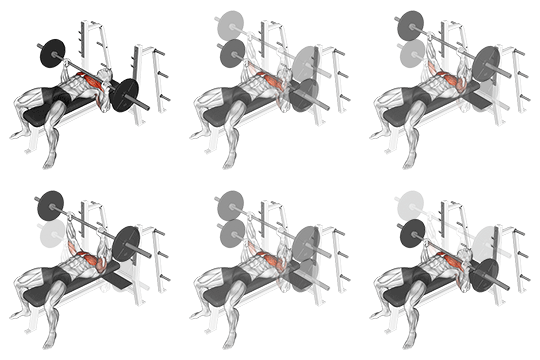
> **Equipment:** Barbell · **Target:** Pectorals · **Secondary:** Triceps, Shoulders · **Media ID:** `EIeI8Vf`
The Barbell Bench Press is the cornerstone of chest training and one of the "Big Three" powerlifting movements. Lying flat on a bench, you lower a loaded barbell to your chest and press it back up explosively. It simultaneously recruits the pectorals, triceps, and anterior deltoids, making it the single most effective exercise for upper body pushing strength and chest mass development.
**Key cues:** Retract and depress your scapulae before unracking. Keep your feet flat on the floor, arch your lower back naturally, and maintain a shoulder-width grip. Lower the bar under control to mid-chest and drive up through the heels.
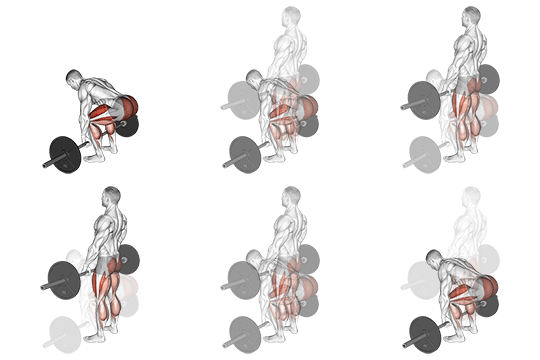
### 2 — Barbell Deadlift · Upper Legs / Back
> **Equipment:** Barbell · **Target:** Glutes · **Secondary:** Hamstrings, Lower Back · **Media ID:** `ila4NZS`
The Barbell Deadlift is widely regarded as the ultimate full-body strength exercise. It engages virtually every major muscle in the posterior chain — glutes, hamstrings, and lower back — while also demanding significant contribution from the upper back, traps, and grip. Proper spinal alignment and bracing technique are critical for both performance and safety.
**Key cues:** Set up with the bar over your mid-foot. Hinge at the hips, grip just outside your legs, brace your core hard, and keep the bar in contact with your shins throughout the lift. Drive the floor away, lock out at the top by squeezing glutes and extending hips fully.
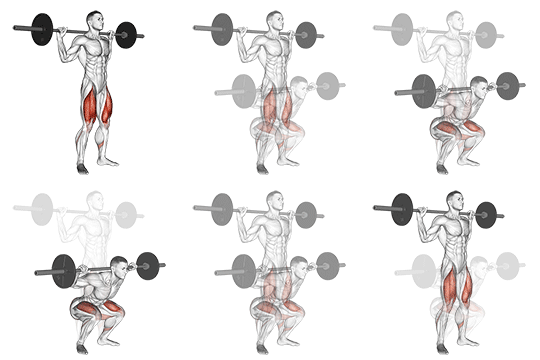
### 3 — Barbell Full Squat · Upper Legs
> **Equipment:** Barbell · **Target:** Glutes · **Secondary:** Quadriceps, Hamstrings, Calves, Core · **Media ID:** `qXTaZnJ`
Often called "the king of all exercises," the Barbell Full Squat demands coordinated strength across the entire lower body and core. Breaking parallel maximizes glute and hamstring activation compared to partial squats. It is the foundation of nearly every strength and hypertrophy program.
**Key cues:** Bar on upper traps (high bar) or rear deltoids (low bar). Brace your core before descent, push knees out in line with toes, sit into your hips, and descend until your thighs pass parallel to the floor. Drive through the whole foot to stand.
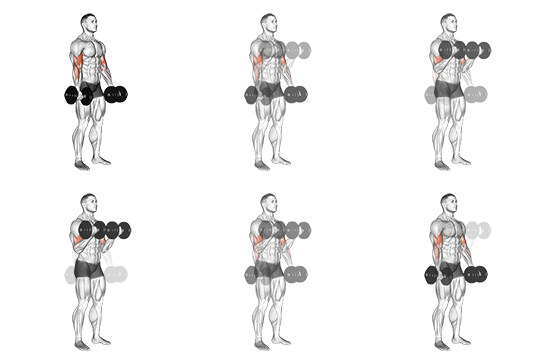
### 4 — Dumbbell Biceps Curl · Upper Arms
> **Equipment:** Dumbbell · **Target:** Biceps · **Secondary:** Forearms · **Media ID:** `NbVPDMW`
The Dumbbell Biceps Curl is the most recognized isolation exercise for the arms. Training each side independently helps identify and correct strength imbalances between limbs. The supinated (palms-up) grip maximizes biceps contraction at the top of the movement.
**Key cues:** Stand tall with elbows pinned to your sides. Supinate your wrists as you curl up, squeeze at the top, and lower under control without swinging. Avoid using momentum from the shoulders or lower back.
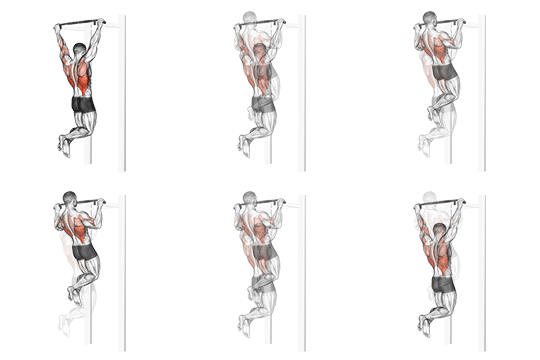
### 5 — Pull-up · Back
> **Equipment:** Body Weight · **Target:** Lats · **Secondary:** Biceps, Forearms · **Media ID:** `lBDjFxJ`
The Pull-up is the gold standard bodyweight exercise for upper body pulling strength. It primarily develops the latissimus dorsi — creating the coveted V-taper — while heavily involving the biceps, rear deltoids, and core stabilizers. It scales from beginner (band-assisted) to advanced (weighted).
**Key cues:** Dead hang from an overhand grip, shoulder-width or slightly wider. Initiate with your lats by depressing your shoulder blades, then pull your chest toward the bar. Lower fully between reps to maintain range of motion.
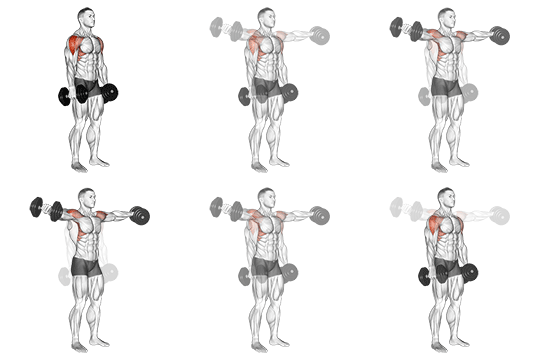
### 6 — Dumbbell Lateral Raise · Shoulders
> **Equipment:** Dumbbell · **Target:** Delts · **Secondary:** Traps · **Media ID:** `DsgkuIt`
The Dumbbell Lateral Raise is the go-to isolation exercise for building shoulder width. It directly targets the lateral (middle) head of the deltoid, which is responsible for the broad-shouldered look. Controlled tempo and strict form matter far more than load.
**Key cues:** Stand with a slight bend in your elbows throughout. Raise the dumbbells out to the sides until your arms are parallel to the floor — no higher. Lead with your elbows, not your wrists. Lower slowly under control to maximize time under tension.
---
## 🚀 Usage Examples
### Python — Load and Filter
```python
import json
with open("data/exercises.json", "r", encoding="utf-8") as f:
exercises = json.load(f)
print(f"Total exercises loaded: {len(exercises)}")
# Filter by category
chest_exercises = [ex for ex in exercises if ex["category"] == "chest"]
print(f"Chest exercises: {len(chest_exercises)}")
# -> Chest exercises: 163
# Filter by equipment
bodyweight = [ex for ex in exercises if ex["equipment"] == "body weight"]
print(f"Bodyweight exercises: {len(bodyweight)}")
# -> Bodyweight exercises: 325
# Get all unique categories
categories = sorted({ex["category"] for ex in exercises})
print("Categories:", categories)
# Access multilingual instructions
ex = exercises[0]
print(ex["instructions"]["en"]) # English
print(ex["instructions"]["es"]) # Spanish
print(ex["instructions"]["it"]) # Italian
print(ex["instructions"]["tr"]) # Turkish
print(ex["instructions"]["ru"]) # Russian
print(ex["instructions"]["zh"]) # Chinese
print(ex["instructions"]["hi"]) # Hindi
print(ex["instructions"]["fr"]) # French
```
### Python — Load with Pandas
```python
import json
import pandas as pd
with open("data/exercises.json", "r", encoding="utf-8") as f:
data = json.load(f)
df = pd.DataFrame(data)
# Top categories by exercise count
print(df["category"].value_counts().head(10))
# All barbell exercises targeting upper legs
barbell_quads = df[(df["equipment"] == "barbell") & (df["category"] == "upper legs")]
print(barbell_quads[["name", "target", "equipment"]])
```
### JavaScript / Node.js
```js
const exercises = require("./data/exercises.json");
console.log(`Total exercises: ${exercises.length}`);
// Bodyweight exercises only
const bodyweight = exercises.filter(ex => ex.equipment === "body weight");
console.log(`Bodyweight exercises: ${bodyweight.length}`);
// -> Bodyweight exercises: 325
// Group exercises by category
const byCategory = exercises.reduce((acc, ex) => {
acc[ex.category] = (acc[ex.category] || []);
acc[ex.category].push(ex);
return acc;
}, {});
// Access multilingual instructions
const ex = exercises[0];
console.log(ex.instructions.en); // English
console.log(ex.instructions.es); // Spanish
console.log(ex.instructions.it); // Italian
console.log(ex.instructions.tr); // Turkish
console.log(ex.instructions.ru); // Russian
console.log(ex.instructions.zh); // Chinese
console.log(ex.instructions.hi); // Hindi
console.log(ex.instructions.pl); // Polish
console.log(ex.instructions.ko); // Korean
console.log(ex.instructions.fr); // French
```
### TypeScript — Type-safe Usage
```typescript
interface Exercise {
id: string;
name: string;
category: string;
body_part: string;
equipment: string;
instructions: {
en: string;
es: string;
it: string;
tr: string;
ru: string;
zh: string;
hi: string;
pl: string;
ko: string;
fr: string;
};
muscle_group: string;
secondary_muscles: string[];
target: string;
media_id: string | null;
image: string | null;
gif_url: string | null;
attribution: string;
created_at: string;
}
import exercises from "./data/exercises.json";
const data = exercises as Exercise[];
const randomWorkout: Exercise[] = data.slice(0, 6);
console.log("First 6 exercises:", randomWorkout.map(e => e.name));
```
---
## 📄 License & Use
This repository is a **developer setup wizard and structured exercise dataset** — exercise metadata, multilingual instruction translations, and 180×180 exercise media.
- **Code, tooling, dataset structure, and instruction text** are released under the [MIT License](LICENSE).
- **Exercise media (images & GIFs) is © [Gym visual](https://gymvisual.com/)** and redistributed here **with permission**, at 180×180 resolution — see [`NOTICE.md`](NOTICE.md) and the media exception in [`LICENSE`](LICENSE). Keep the `© Gym visual — https://gymvisual.com/` attribution intact. Reuse is governed by [Gym visual's Terms & Conditions](https://gymvisual.com/content/3-terms-and-conditions-of-use); obtain your own license there before reusing the media.
- This repository does **not** claim ownership of the underlying exercise content or media.